
IFP Update: February 2026
📣 Announcements
Brielle Hill joined us as our Director of Operations. Previously, Brielle was the Chief of Staff for the Economic Security and Technology Department at CSIS and Associate Director for the Wadhwani AI Center.
📰 Media
The New York Times quotes Tim Fist on the shortcomings of China’s chip industry:
“Chinese companies will most likely make just 2% as many AI chips as foreign firms do this year.”
The Washington Post mentions IFP’s work on building energy capacity fast to power AI development.
The Wall Street Journal cites Connor O’Brien’s research showing that computer scientists earn “63% more than the typical young graduate, up from 47% in 2009.”
Bloomberg Law quotes Connor on how Texas and Florida’s new H1-B restrictions could leave their states with fewer doctors.
Business Insider cites Connor's analysis of the Census Bureau’s American Housing Survey in a discussion of whether the age of first-time homebuyers is actually going up.
Poynter cites our analysis showing how exporting H200s without restrictions could shrink America’s compute advantage.
Reason quotes Will Poff-Webster’s support of Congress’s proposed updates to the PRO Housing program.
✍️ Policy Reports
How to Create Real Permitting Certainty. Aidan Mackenzie explains how the bipartisan FREEDOM Act can break the cycle of executive abuse in federal permitting by setting universal timelines, preventing revocation of approved permits, and backing these protections with enforceable legal remedies.
Breaking the NEPA Litigation Doom Loop. Ben Schifman examines how NEPA traps infrastructure projects in cycles of review, litigation, and re-review lasting years — even though agencies prevail in ~80% of cases. He then presents several options for reform, from barring courts from halting projects to more targeted fixes.
Beyond AlphaFold. Dan Turner-Evans shares a framework for how science funders can unlock more AlphaFold-like breakthroughs with targeted investments in datasets, domain expertise, and compute.
🏛️ Statecraft by Santi Ruiz

How to Rewire City Hall. Santi interviews James Anderson of Bloomberg Philanthropies about how his team helped more than 900 cities build problem-solving capacity. They discuss why local governments are stuck in a Fordist model and what it takes to help mayors govern differently.
What’s Wrong with Nonprofits? Santi and Greg Berman, author of The Nonprofit Crisis, discuss why public trust in nonprofits has eroded, how the federal and local governments depend on NGOs for service delivery, and what nonprofit leaders can do to refocus on mission.
How a Congressional Office Actually Works. Santi interviews Baillee Brown, former chief of staff to Congressman Scott Peters, about the inner workings of a House office, from how schedulers control members’ time to how legislative assistants juggle eight issue areas at once.
When FAFSA Broke, They Called This Guy. Santi interviews Jeremy Singer, president of the College Board, about his six months salvaging the botched 2023 FAFSA redesign at the Department of Education and how the fix made 1.7 million more students eligible for maximum Pell Grants.
🏗️ Construction Physics by Brian Potter
Trends in US Construction Productivity. Brian examines decades of data showing that US construction productivity has been essentially flat since the 1960s, even as productivity in the rest of the economy tripled. He then walks through why different metrics all point to the same trend.
Is the Future “AWS for Everything”? Brian explores whether capital-intensive industries could follow the cloud computing model: large-scale operations producing a wide range of outputs in low volumes, and where the model is most likely to work.
🏭 Factory Settings by Mike Schmidt, Todd Fisher, and Sara Meyers
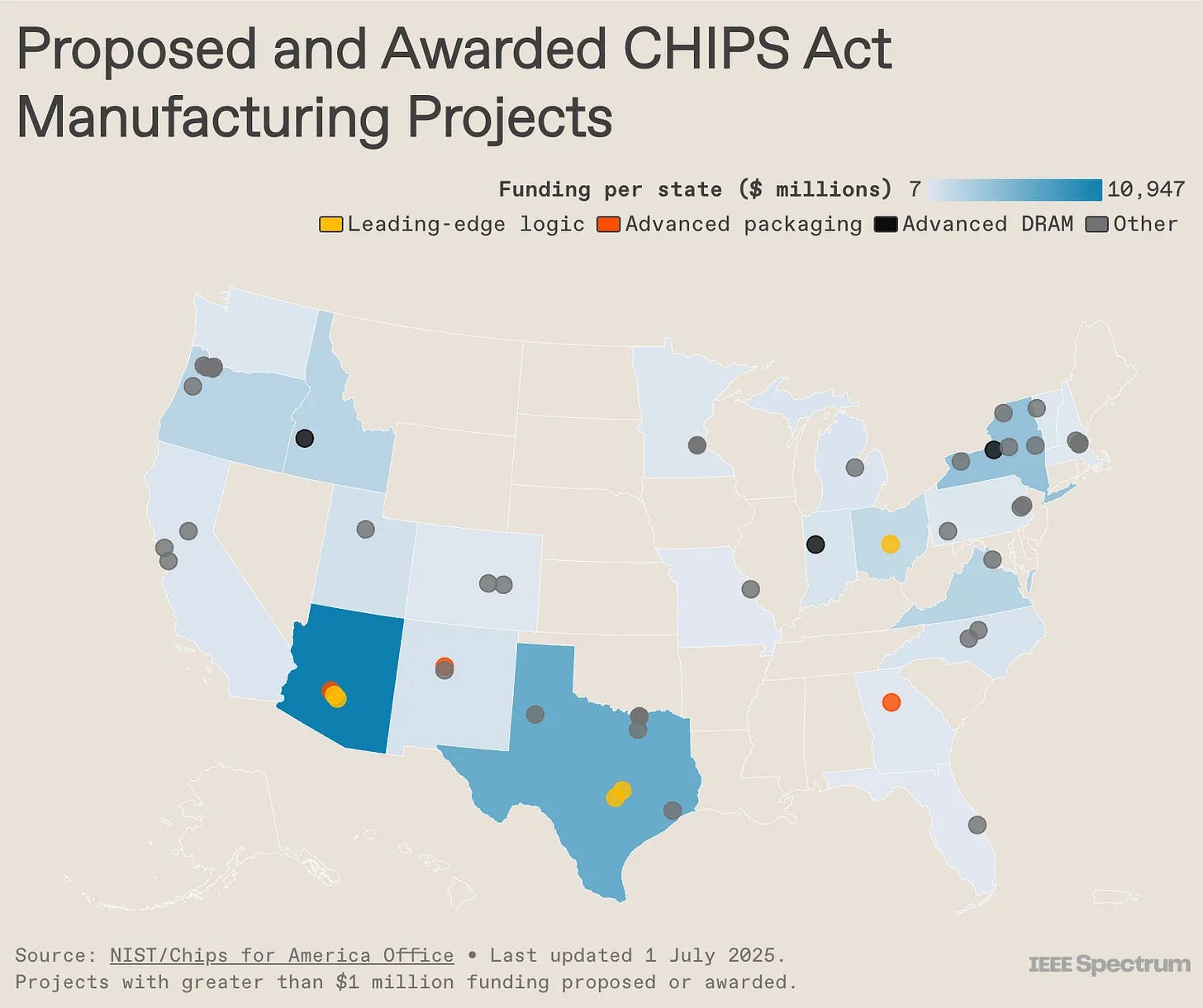
How the US Won Back Chip Manufacturing. In a crosspost with ChinaTalk, Mike Schmidt and Todd Fisher discuss how the CHIPS program catalyzed the biggest semiconductor buildout in memory and when similar interventions might be warranted.
A User’s Guide to Government Equity Investing. Arnab Datta proposes a four-part test for evaluating government equity stakes in private companies, arguing that equity is a useful industrial policy tool but needs guardrails to avoid politicized mismanagement.
Getting What You Want from Industrial Policy. Todd Fisher explains how the CHIPS team used tailored milestones to ensure accountability: they unlocked funding only when companies hit specific operational targets, turning federal grants into something closer to private equity.
🔬 Macroscience by Andrew Gerard
Do Not Surrender to the Tech Tree. Tao Burga defends technological determinism — the idea that the tech tree’s structure largely determines which technologies emerge — but argues that deliberate action can still shape when and how they develop, even as AI narrows the window for steering outcomes.
👋 Tweet for the Road

Iran's Shi'a-deranged ayatollahs, and their agents or sympathizers, have been killing US citizens for decades while also working on building nukes in order to kill even more people. They loudly proclaimed that their primary targets are Israel and the US. The same targets tried to talk them out of their mass-murdering intentions, and even tried bribing them with large amounts of money.
Talks, and bribes, didn't work.
When even their own subjects, the Persian (=Iranian ?) people protested against their policies, the ayatollahs' henchmen cheerfully butchered tens of thousands.
What to do, what to do? went the world's leaders.
POTUS Trump is stopping the madness.
The world should be grateful.