
IFP Update: June 2026
We hope everyone had a lovely Independence Day weekend!
📣 Announcements
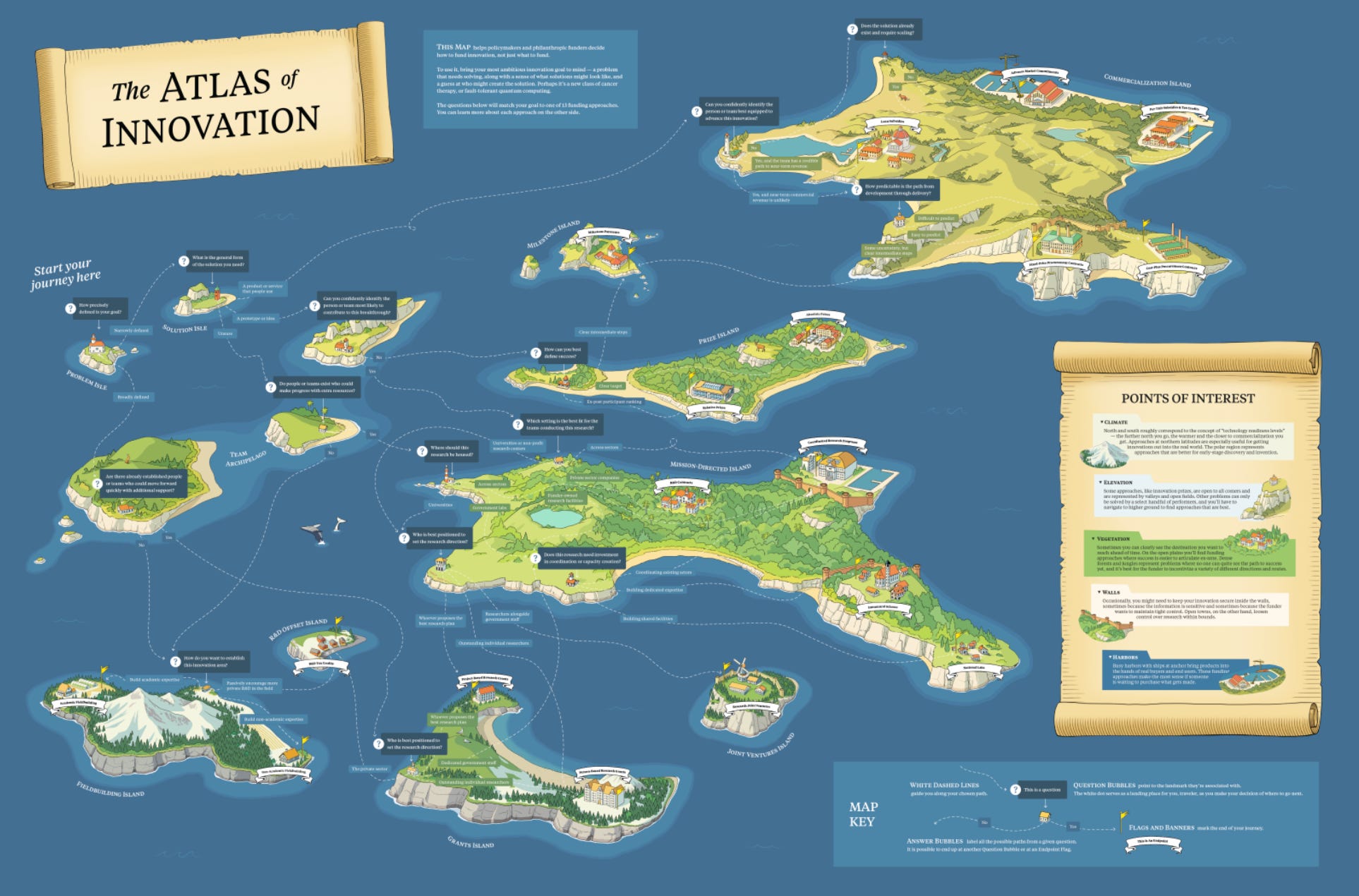
Last month, we launched a few major projects:
The Atlas of Innovation, a tool to help funders navigate the world of innovation funding mechanisms. As funders answer questions about their innovation goal, the Atlas guides them to one of 13 funding approaches in the innovation library, explaining when the approach works well and how it can fail.
The Transit Abundance Playbook, a collection of 15 concrete ideas to build transit faster and cheaper, including better upfront planning, leaner designs, itemized and value-based procurement, single accountable project decision-makers, and faster permitting for voter-approved projects.
IFP and FAI co-organized an open letter urging Congress to require screening of commercial DNA orders for bioweapons. The letter was signed by Sam Altman, Dario Amodei, Demis Hassabis, and many others, and received coverage from the Wall Street Journal, Wired, and Fortune. Alongside the letter, we also published a report from Sentinel Bio: How to Secure the DNA Supply Chain.
👋 Welcome
Liam Epstein joins our Emerging Tech team as an Associate Fellow to work on AI policy and technical state capacity. Liam previously worked at CNAS as a Research Associate.
We have two new hires on the Operations team: Zigmund Forrest joins us as an Operations Associate, and Eitan Casaverde joins us as an Operations Coordinator.
📰 Media

Slow Boring featured Arnab Datta and Will Poff-Webster’s How to Fix Transit Construction in America, the introduction to the Transit Abundance Playbook. Will also appeared on the Talking Headways podcast.
Bloomberg quoted Saif Khan on two rules relating to export controls on AI chips in the context of NVIDIA sales of Blackwell chips, a topic covered by this IFP report from October 2025.
The Washington Post cited Santi Ruiz’s Statecraft podcast with Randy Clarke, head of the D.C. Metro, in a piece on free buses in Kansas City.
Marketplace featured Brian Potter in a radio piece on the US shipbuilding revival’s reliance on Finnish icebreakers, a topic he’s previously covered on Construction Physics.
Bloomberg Law quoted Amy Nice on the USCIS’s inability to add green-card criteria without formal rulemaking.
IEEE Spectrum quoted Jenn Gustetic on the National Science Foundation’s X-Labs solicitation.
E&E News quoted Ben Schifman on the recent debate around overhauling the National Historic Preservation Act.
Florida Trend quoted Connor O’Brien throughout H-1B Limbo, a piece on Florida’s pause on university H-1B sponsorship.
Science|Business’s David Matthews interviewed Matthew Esche for a piece on the Atlas of Innovation in the context of European science funding.
📋 Policy work
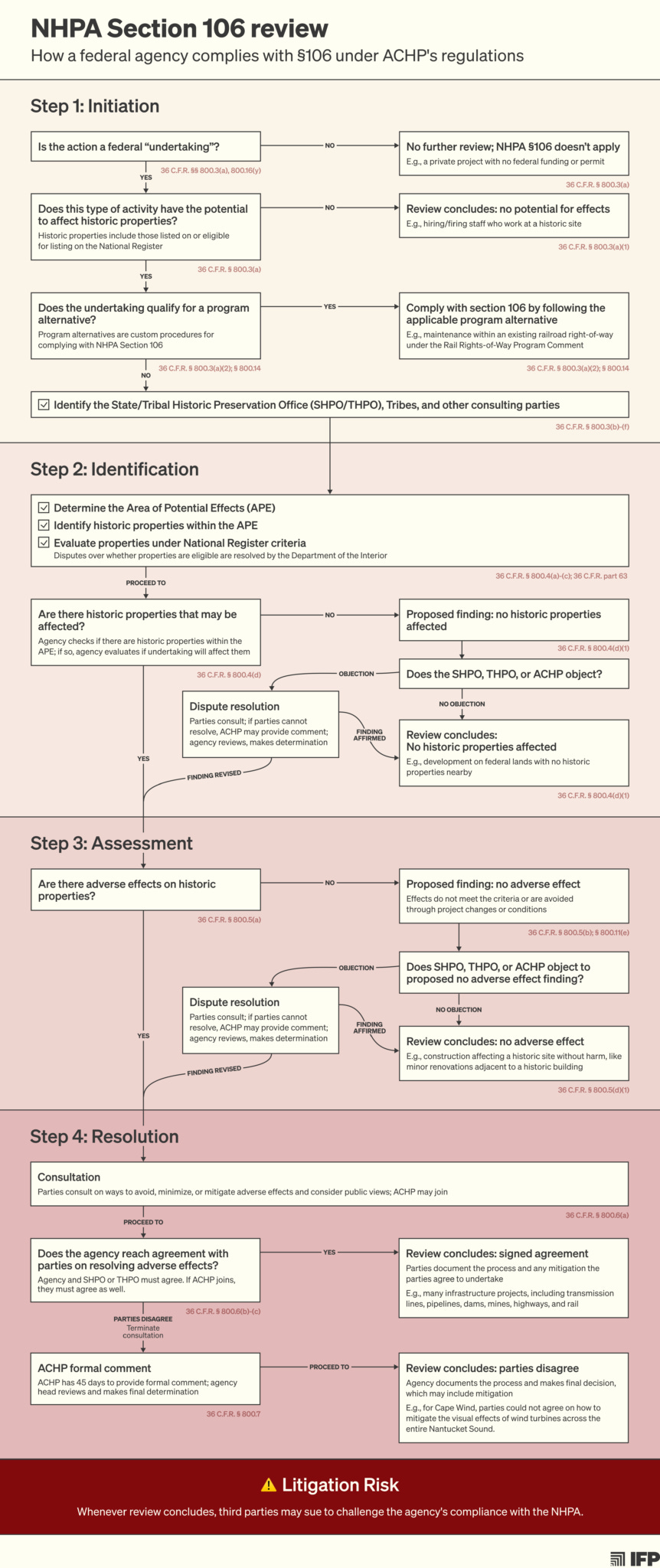
Reforming Section 106 of the National Historic Preservation Act. Ben Schifman and Aidan Mackenzie show how historic preservation, originally a modest procedural check, swelled into a substantial brake on energy and other infrastructure. They propose right-sizing it by limiting review, capping visual-impact studies (so one transmission line doesn’t trigger thousand-square-mile analyses), and setting statutory deadlines for each step, in line with recent NEPA reforms.
A Speed-for-Security Bargain for AI Data Centers. Ben Schifman argues that keeping the next generation of AI R&D onshore depends on grid interconnection that is both fast and secure. In this report, he lays out how the Federal Energy Regulatory Commission can speed interconnection while hardening the grid against the risks that come with it.
Every public comment on DOL’s prevailing wage rule. Our High-Skilled Immigration team built a microsite to display public comments to the Department of Labor’s prevailing wage rule.
✍️ Statecraft
The Strongman Presidency. Santi talks with Johns Hopkins University’s William Howell and Stanford’s Terry Moe about their 2025 book on the rise of executive power, and how a federal workforce that “were mostly mailmen” became a battleground for presidential control.
Merit vs. Tenure: Reforming Federal Firing. Santi speaks with Scott Kupor, Director of the Office of Personnel Management (OPM), and Scott’s Senior Advisor, Noah Peters. Together, they dig into why the rules for how and whether federal employees can be fired have become “so incredibly unadministerable.”
🏗️ Construction Physics
Converting Coal Plants to Natural Gas. Brian explains how coal plants are converted to be able to process natural gas. He traces how ~140 US coal plants were converted to burn natural gas since 2008 and explains why the wave is largely over, now that the best candidates are converted and grid batteries undercut gas peakers.
How Long Does It Take to Plan a Bridge? Brian looks into the history of bridge building and repair, analyzing 67 major bridges built since 1900. He finds construction times roughly doubled (from 3.1 years on average in 1940–59 to 6.5 by the 1980s–90s) while planning timelines held steady at about a decade, and that the construction efforts moving fastest today are bridge replacements.
US Subways Build Too Many Cross Passages. In this piece from the Transit Abundance Playbook, Brian shows how a fire-safety rule (NFPA 130’s demand for a connecting passage every 800 feet) that is roughly twice as strict as Europe’s equivalent standard adds millions per passage to subway costs.
Biological Evolution and Information Acquisition. Brian looks at different forms of biological reproduction from an information-theoretic perspective. Through simulations, he shows how sexual reproduction speeds evolution the way modular engineering speeds innovation, by letting many good ideas be tested for advancement at once, instead of trapping them in a single lineage.
🏭 Factory Settings
What Is Economic Resilience? In this cross-post with ChinaTalk, Mike Schmidt and Nikita Lalwani map three kinds of threats (demand shocks, geopolitical coercion, random supply disruptions) against three sources of resilience (stockpiles, domestic capacity, surge ability). They make the counterintuitive case for the benefit of partial progress, showing that even maintaining a quarter of domestic production for a critical input can capture far more than a quarter of the strategic benefit because an adversary’s leverage collapses as their dominance erodes.
🔬 Macroscience

The Six Camps of Metascience. Caleb Watney and Jenn Gustetic offer a field guide to metascience for policymakers, organizing the current field into six camps, each of which diagnoses a different failure and proposes its own improvement program: research integrity, open science, metrics of science, innovation economics, R&D management, and institutional entrepreneurs. They make the case that most durable reform efforts borrow from several camps at once.
Making Our Own Luck. Kris Willis describes a method for predicting scientific breakthroughs years ahead by reading publication patterns in PubMed and proposes testing this method directly by funding half of 30 predicted fields for a decade (~$300M/year) and measuring their progress against unfunded controls.
👋 Tweet for the Road


